Resilience Master Article


Why Is Talking About Resilience So Important
In a VUCA(Volatility, Uncertainty, Complexity and Ambiguity)world, the pace of change is no longer linear—it compounds. Consider three signals. First, the average lifespan of an S&P 500 company has been shrinking for decades and was forecast to drop toward ~12 years by 2027 (Innosight, 2018). Second, six in ten workers will need reskilling by 2027 as roles shift under the pressure of AI, automation, and new business models (World Economic Forum, 2023). Third, technology nowspreadsat breakneck speed: ChatGPT reached an estimated one hundred million users in two months (Reuters, Feb 2, 2023). Strategy scholars have long warned about this reality: Alvin Toffler called it “too much change in too short a time” (1970), and Rita McGrath argues we now compete on “transient advantage” (Harvard Business Review, June 2013).
The cost of not adapting is real. Kodak pioneered digital photography butfailed toinnovate and change fast enough; bankruptcy followed (Reuters, Jan 19, 2012). Blockbuster held on to stores while streaming rewrote consumer behavior, bankruptcy again, for Blockbuster (Reuters, Sept 23, 2010). These are not isolated cautionary tales; they repeat wherever we mistake yesterday’s strengths for tomorrow’s strategy.
The UAE’s Founding Father, the late Sheikh Zayed bin Sultan Al Nahyan, grounded national progress in human capability:“Wealth is not money. Wealth lies in men”(Gulf News, Oct 31, 2005). He also linked resilience to memory and learning:“He who does not know his past cannot make the best of his present and future.”(My Bayut, Sept 23, 2025).For organizations, the lesson is clear: resilience is built in people first, then scaled through teams, then embedded in systems.
That is why creating resilient organizations is a strategic, tactical, and competitive imperative. Strategically, resilience lets you reallocate capital and reinvent offerings at the speed of change (Toffler, 1970; McGrath, 2013). Tactically, it equips teams tooperatecalmly under pressure—prioritizing, problem-solving, and learning in short cycles (WEF, 2023). Competitively, it compounds resilientindividualsmodel steady behaviors; resilient teams normalize openness and honesty, adaptation, and cross-functional support. Resilient systems (governance, metrics, talent, technology) make those behaviors repeatable at scale. The result is a flywheel: people → teams → organization—each layer reinforcing the next
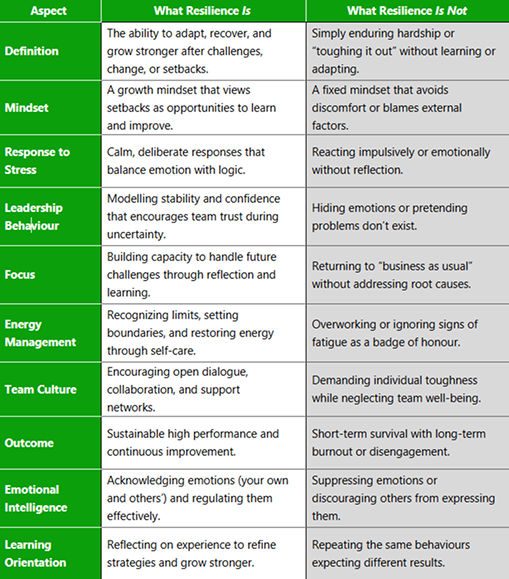
What Resilience Is and What It Is Not
From Insight to Workplace Application
Understanding what resilience is and what it is not gives leaders the insight to translate awareness into meaningful action.
Resilient leadership is not about appearing invincible or suppressing emotion; it’sabout responding with clarity, steadiness, and purpose when faced with challenge or continuous change. The real test of resilience lies in daily moments: pausing before reacting(count till 5,before you react or just take two steps back, before you respond),listening deeply, and turning setbacks into opportunities for growth.
When leaders consistently model thesebehaviors, they create a ripple effect, allowing teams to become more adaptive, communication becomes more open, and performance remains steady even under pressure. By intentionally practicing habits that sustain focus, energy, and connection, resilience moves from being an abstract concept to a lived, visible quality of leadership that inspires others to do the same.
Understanding resilience provides the foundation but what truly matters is how leaders apply itdaily.
Resilient leadership is supported through five interconnected principles that translate awareness into consistent, effective action at workand in life.
Together, these principles turn resilience from a closed mindset into a visible, repeatable practice of confident, steady resilient leadership.
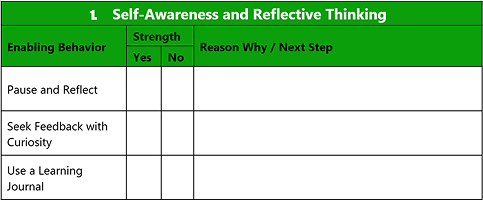
Self-Awareness And Reflective Thinking
Self-awareness is the leader’s ability to notice their own emotions, what triggers them, thought patterns and understanding how these inner states influence behavior and decisions. Reflective thinking is the habit of pausing to analyze experiences, asking “What happened? Why? What can I learn?” then applying those insights to future actions. Together, they allow leaders to respond thoughtfully instead of reacting automatically.
How It Builds Resilience
- Creates calm under pressure through “reflective acting” (thinking and adjusting behavior and attitude while doing).
- Improves decision quality by reducing emotional reactivity.
- Models’ emotional stability and composure toward others.
- Encourages continuous learning from experience.
Workplace Scenario: “Reflective Acting” in Action
Leah manages a technical support team during a major system outage. Atechnician’serror worsens the problem, and the team’s stress rises. Leah feels her frustrationrisingbutpauses. She asks herself, “What does my team need from me rightnow,panicor clarity?”She steadies her tone, assigns clear actions, and calmly coordinates recovery. Later, she debriefs the team,identifieslessons, and updates their process. Leah’s self-awareness and reflection turn chaos into calm control, earning her team’s trust and reinforcing resilience.
Apply on the job:
- Pause and Reflect — Take five minutes after difficult moments to name what you felt and what you can learn from the experience.
- Seek Feedback with Curiosity — Invite trusted colleagues to share how you handle pressure so you can become aware of your blind spots.
- Use a Learning Journal — Write one sentence daily on what strength helped and what you’ll improve next time.
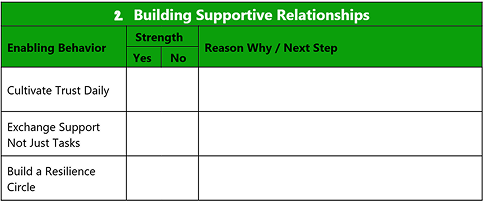
Building Supportive Relationships
Building supportive relationships means cultivating trust-based connections with colleagues, mentors, friends, and family, so you have people to rely on during challenges. In resilience research(2017), these are known as situational factors: external support and supportive environments that sustain wellbeing and performance under pressure.
How It Builds Resilience
- Creates psychological safety through trust and open dialogue.
- Promotes shared problem-solving and mutual accountability.
- Boosts morale and energy through belonging and connection.
- Prevents isolation and reduces risk of burnout.
Workplace Scenario: Support in Action
Nikhil manages a customer service center during peak season. Complaints are rising and his team feels drained. Instead of pushing through alone, Nikhil calls a peer for advice, then meets his team to acknowledge their stress and ask for ideas. Two volunteers propose a rotation system to ease workloads. Within days, performance improves and morale lifts. By leaning on support and fostering trust, Nikhil demonstrates that resilience grows through community, not isolation.
Apply on the job:
- Cultivate Trust Daily — Be honest about challenges; openness builds respect and authentic connection.
- Exchange Support Not Just Tasks — Ask “how are you coping?” as often as “is the report done?”
- Build a Resilience Circle — Stay connected to three people you can call for advice or encouragement.
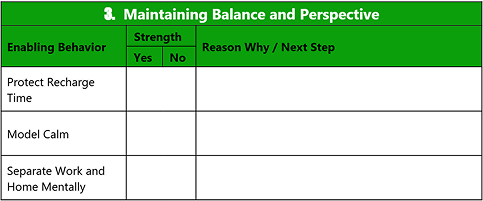
Maintaining Balance And Perspective
Maintaining balance and perspective means managing your energy and emotions so pressure doesn’t overwhelm your focus or judgment. Förster & Duchek (2017)highlighted work-life balance, relaxation, and emotional regulation as protective factors that help leaders recover faster and think clearly.
How It Builds Resilience
- Restores focus and decision quality by avoiding fatigue.
- Promotes emotional steadiness and recovery.
- Broadens perspective, seeing the bigger picture while under stress.
- Sustains long-term performance and wellbeing.
Workplace Scenario: Balance in Action
Clara, a logistics manager, faces a supplier crisis before a key delivery. Her stress rises sharply, but she recognizes fatigue clouding her judgment. She steps outside, takes a brief walk, and resets her focus. Returning, she calmly prioritizes shipments, delegates tasks, and ends work on time to rest. The next morning, refreshed, she spots a creative workaround that saves the client order. Clara’s ability to pause and regulate emotions turns exhaustion into effective action, a key feature of resilient leadership.
Apply on the job:
- Protect Recharge Time — Schedule non-negotiable breaks or exercise to reset energy and mood.
- Model Calm — Use measured tone and pace; your steadiness reduces team tension.
- Separate Work and Home Mentally — Switch off devices after hours to build a clear boundary.
Structured Problem Solving And Calm Action
Structured problem-solving means breaking complex challenges into clear, manageable steps. Calm action is maintaining composure while executing those steps logically and transparently. In Förster & Duchek’s2017study, interviewed leaders used reflective acting (acting while simultaneously monitoring and adjusting your behavior in real time),data gathering, and analytical thinking to remain effective under pressure.
How It Builds Resilience
- Reduces anxiety through structure and clarity.
- Encourages rational, evidence-based decision-making.
- Builds credibility and team confidence during crises.
- Turns pressure into learning through adaptive reflection.
Workplace Scenario: Calm in Chaos
David leads IT operations at a manufacturing firm. When the order-tracking system crashes before an audit, panic spreads. David grounds himself and directs his team:“ Define the problem, identify impact, assign roles. ”They check logs, contact the vendor, and document every step. Within two hours, systems are restored, and stress is contained. His structured calm becomes the model for future incident responses, proving that clarity and composure are the real engines of resilience.
Apply on the job:
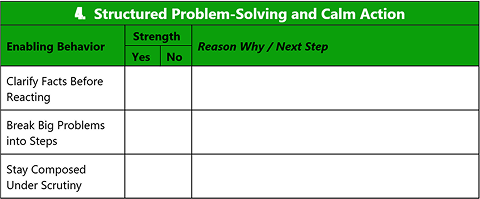
- Clarify Facts Before Reacting — Gather data from multiple sources to avoid snap judgments.
- Break Big Problems into Steps — Simplify workloads and assign achievable next actions.
- Stay Composed Under Scrutiny — Speak slowly, breathe steadily, and reassure through tone not just words.
Learning And Adapting From Experience
Learning and adapting from experience means turning setbacks into insights and applying them to future challenges. Förster & Duchek (2017) found that experience, reflection, and adaptive thinking help leaders transform difficulty into competence over time.
How It Builds Resilience
- Converts adversity into long-term capability.
- Strengthens self-confidence through visible progress.
- Encourages experimentation and flexibility.
- Creates a growth-minded team culture that values improvement over perfection.
Workplace Scenario: Turning Setback into Strength Marina’s team misses a major delivery deadline which shakes their morale. Instead of assigning blame, she facilitates an open debrief to map what went wrong. Together, they find gaps in testing and handovers, then redesign their workflow. She shares these lessons across teams, showing that growth comes from reflection, not fault-finding. The next project launches early—and stronger. Marina’s approach embodies resilience: learning, adapting, and rising smarter each time.
Apply on the job:
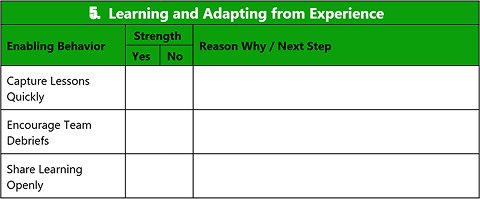
- Capture Lessons Quickly — Note what worked and why within 24 hours of a challenge.
- Encourage Team Debriefs — After projects, ask “what did we learn?” not “who messed up?”.
- Share Learning Openly — Talk about your own mistakes to normalize continuous improvement.
Call To Action
Celebrate what you already do well. Pick one behavior from each principle to practice this month. Track your progress and share one learning each week with a peer or mentor. Resilience grows by choice and consistency. When practiced consistently, these micro-habits create a transformative effect, like a flywheel — sustaining momentum and embedding resilience as a natural part of how you think, act, and lead.
Reflective Questions
Which of the behaviors for each resilience pillar is your current strength, and which needs development?
Feedback
How Effective Am I doing?
Instructions
Step 1.
Before sharing the exercise, explain to your team that this is part of yourpersonal leadership developmentandcommitment to leading with resilience. Emphasize that:
- Feedback will be used for your personal growth, not appraisal.
- Responses can be shared anonymously (if using a digital form) or confidentially (if via facilitator).
- You value honesty and psychological safety.
Step 2
Provide each team member with the short feedback form (three core questions listed below). This can be administered through:
- A printed sheet in a team reflection meeting.
- An anonymous digital survey (e.g. Microsoft Forms, Google Forms, or SurveyMonkey).
- A facilitated session by HR, a coach, or an external consultant.
Step 3
Each team member rates and comments on the following three areas:
- Consistency:
My manager stays calm and solution-focused when things go wrong.
- Connection:
We feel safe to share honest feedback, concerns and new ideas with our manager.
- Growth:
My manager helps the team reflect and learn from challenges rather than avoid them.
Step 4
Collection and Review
- Allow one week for responses.
- Review the results privately first, then share a short summary with the team highlighting:
- What you’re proud of.
- What you’ll work on.
- How the team can support mutual resilience practices.
Step 5
Action and Follow-Up
- Integrate one or two key insights into your leadership habits (e.g., pausing before reacting, inviting weekly reflections).
- Revisit this exercise every 6–12 months to track your growth.
Tips for Success
- Keep the tone appreciative and open.
- Ask clarifying questions if feedback is unclear, not defensive ones.
- Thank every participant for their honesty and trust.
- Close the loop by showing how you acted on the feedback.
Summary
Resilienceisn’tabout avoiding stress —it’show you respond to it. Förster&Duchek(2017)found that leaders thrive when they combine personal strength, supportiverelationshipsand structuredbehaviors. Reflection, connection, balance, problem-solving and continuous learning work together to keep leaders effective under pressure. These skills can all be developed through daily practice and feedback. When you model resilience, you build a trust-based team culture that handles change with energy and optimism.
.png)
