Feedback Master Article


Introduction
Why Quality Feedback Matters?
Quality feedback is not a speech; it is a system for accelerating learning. At its core, quality feedback is timely, specific, and improvement-focused. It points to a recent situation, names the observable behavior and its impact, and ends with an agreed next step. It is not a character judgment, a vague opinion, or a once-a-year surprise. Leaders who build this capability outperform those who do not because rapid learning loops compound: teams correct sooner, standards become clearer, and execution gets faster. Organizations that adopt continuous feedback report ~24% better performance than those relying on infrequent reviews, (Betterworks, 2019/2020).
Frequent, meaningful feedback also lifts engagement: Gallup, finds that employees who received meaningful feedback in the last week are far more likely to be fully engaged (Gallup, 2022). In practice, employees rate feedback ~5× more meaningful when delivered weekly versus annually, and 94% prefer real-time feedback and development conversations (Select Software Reviews, 2025). Meanwhile, 77% of HR leaders say annual reviews are inaccurate, and 85% of employees would consider quitting after an unfair review, evidence that infrequent, judgment-heavy systems can backfire, (Select Software Reviews, 2025).
Finally, sustained human-to-human feedback loops are linked to stronger retention; continuous-feedback programs have been associated with ~44% higher retention over time (Betterworks, 2019/2020; summarized in Select Software Reviews, 2025).
Successful leaders consistently give and invite clear feedback; they learn faster, correct sooner, and compound wins and companies using continuous feedback have shown ~44% higher retention, (Select Software Reviews, 2025, January 7, citing Betterworks 2019–2020; Skill Lake, 2023, November 21)
Taken together, these findings make a simple, evidence-based case: if you want better performance, safer operations, higher engagement, and steadier talent retention, develop the capability to give and invite quality feedback. It is one of the highest leverage habits a leader can build.
The Five Capabilities
Why These Five Capabilities Matter
Because feedback is a system, not a speech. Leaders need to consider these five capabilities to turn moments into momentum. First, delivering clear, timely guidance raises accuracy and trust. Second, increasing acceptance ensures feedback is heard rather than resisted. Third, tailoring to context, culture, and channel prevents harm and boosts impact especially in multicultural organisations and hybrid teams. Fourth, scaling through rituals and metrics keeps quality high when span of control is large. Fifth, receiving feedback well fuels personal growth and models the behavior you expect from others. Together these areas create a practical, repeatable operating rhythm that improves performance, engagement, and safety, while advancing strategic execution.
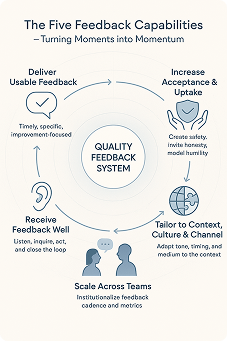
Capability 1
How Can I Deliver Feedback That Others Can Use Immediately?
Why this question matters. Relevance decays with time; the longer you wait, the less useful feedback becomes. Frequent, concrete feedback shortens the learning loop, prevents surprises, and boosts safety, accuracy, and fairness. Infrequent, annualized reviews amplify recency bias and memory gaps. According to Select Software Reviews (2025), 77% of HRleaders do not believe annual reviews give an accurate picture, and 85% of employees would consider quitting after an unfair review.Actions you can take:
- Debrief within 72 hours.
- Add a 10-minute “After-Action” to meetings or shifts. Say: “In today’s handover (Situation), you skipped the risk summary (Behavior); Ops needed ten extra minutes to clarify (Impact). Next time, open with a 2-line risk summary so night shift can act faster.”
- Pair keep & do-differently.
- Always acknowledge one strength and one improvement. Say: “Your client recap was concise; keep that. Do differently: pause once to invite questions so stakeholders feel heard.”
- Avoid vagueness; specify the standard.
- Say: “Against our incident-report standard (all fields + timestamp), your note missed actions and owner. By 16:00 today, add the action, owner, and due date; I will check at 16:15.” (Specific behavior, gap to standard, and a dated next step.)
Capability 2
How Do I Increase Acceptance And Uptake Of My Feedback?
Why this question matters. Even perfectly worded feedback fails if people feel unsafe or unheard. Psychological safety and leader humility make feedback conversations honest and productive; where safety is low, dialogue becomes guarded and superficial. Humble leadership raises employees’ feedback-seeking, especially where job insecurity is high because it signals respect and lowers threat.
Actions you can take:
- Name safety, then prove it. Start with fallibility and gratitude; respond without retaliation. Script: “I may miss things please tell me where I am wrong. Thank you for raising that; let us fix it together.” (Repeat the “thank you” when the person risks being honest.)
- Co-create the next step. Ask what will work in their context and agree on one change and a date. Script: “Here are two options; which feels most workable by Friday?” (Write it down and review in the next 1:1.)
- Invite upward feedback first. Open 1:1s with “What’s one thing I could do better to support you?” The request itself models humility and raises future receptivity to your feedback.
Safety makers vs. Safety breakers: Safety Makers admit fallibility, ask genuine questions, recognize improvements. Safety Breakers: public shaming, sarcasm, inconsistent standards, never acting on your promises and defensiveness.
Capability 3
How Do I Tailor Feedback To Context, Culture, And Channel?
Why this question matters. Context is everything: urgency, consequences, culture, power distance, and work distribution (hybrid/remote) working teams, all this shape how direct you should be and which medium to use. Frequent, specific, improvement-focused feedback still wins across all contexts, but delivery must fit the setting.
Actions you can take:
- Match urgency to risk. Safety-critical: “Stop now the valve is out of spec; lock-out, tag-out, then re-check.”
- Creative/strategic “Solid concepts on modular pricing and guided onboarding. By Mon, 20 Oct, 12:00, include a 60-second risk frame after the solution sketch: three bullets risk, mitigation, owner plus a one-line fallback. Target: reduce ‘what if…’ questions by 50% and gain stage-gate sign-off.”
- Respect power distance and cultural norms. High-Power Distance (PD) example: Give critical points privately; tie to shared goals; avoid embarrassing individuals. “To meet our customer-promise metric, let’s add a 2-minute Q&A pause next briefing; I’ll back you in the meeting.” Low-PD example: Be frank but respectful. Script: “You cut off Alice twice; it reduced clarity. Next time, I will queue speakers jump in after the timer.” (Learn local norms; avoid public embarrassment in high-PD cultures.)
- Choose the right channel in hybrid teams. Use video/in-person for complex/sensitive topics; use chat/email for quick praise or micro-corrections; always document agreements and mind time zones with shared notes and deadlines. Bias guardrails (gender & generational gap): Keep feedback behavioral (avoid gendered labels like “bossy”); apply equal scrutiny/praise; negotiate cadence many younger staff prefer bite-sized frequent input; some older staff prefer fewer, deeper conversations.
Capability 4
How Do I Scale Feedback Across A Busy Schedule And A Large Team?
Why this question matters. Leaders with span-of-control pressures can slide into “feedback droughts,” which lower fairness, engagement, and retention. Continuous feedback, by contrast, creates many data points and fewer surprises; it is measurably linked to accuracy, morale, and staying power.
Actions you can take:
- Institutionalize rituals. Cadence: Bi-weekly 15-minute 1:1s; monthly 45-minute team retro; quarterly development conversations. Script for invites: “Agenda: 5′ wins, 5′ improvement, 5′ actions. Bring one example.”
- Use peer and “office-hours” models. Peer reviews: “Swop draft proposals by Wednesday; give one keep/one change in comments.” Office hours: “Thursdays 14:00–15:00 for live coaching; bring one scenario.” (Track uptake in your log.)
- Track and publish simple metrics. Measure feedback frequency (notes per month), climate (“I receive useful feedback,” “I feel safe giving feedback upward”), and adoption (e.g., “90% of managers completed a 60-day feedback check-in”). Compare performance/retention over time; continuous-feedback organizations show higher retention.
Capability 5
How Do I Receive Feedback Like A Pro And Make It Stick?
Why this question matters. Leaders with a learning goal orientation and strong EQ are more receptive, seek more input, and improve faster. Feedback orientation positively correlates with learning orientation, and emotional regulation prevents the “defensive spike” that derails learning.
Actions you can take:
- Prime your mindset (before the meeting). Why: Turns defence into learning. Mindset: “This is just data.” Behaviors: Breathe; write 1 question. Examples: “What’s one thing I should do more?” / “What should I stop this month?”
- Listen and inquire (during). Why: Clarifies facts. Mindset: Curiosity over rebuttal. Behaviors: Do not interrupt; ask for examples. Examples: “When did you notice that pattern?” / “What would ‘better’ look like next time?”
- Paraphrase and confirm (during). Why: Shows understanding. Mindset: Accuracy first. Behaviors: “So you saw X, which led to Y right?” Examples: “My late agenda caused confusion; I see that.” / “I need to involve you earlier agreed?”
- Thank and choose one action (closing). Why: Reinforces honesty; creates momentum. Mindset: Appreciation beats ego. Behaviors: Name one change + date. Examples: “I’ll send agendas 24h ahead.” / “I’ll mute and hand-raise to avoid interruptions.”
- Close the loop. Why: Converts insight to improvement. Mindset: Accountability. Behaviors: Re-check effect. Examples: “Two weeks in are meetings clearer?” / “Have interruptions reduced?”
Two Proven Tools (SBI & COIN) To Strengthen Your Feedback Conversations
SBI (Situation–Behavior–Impact) by Sloan R. Weitzel, CCL and COIN (Context–Observation–Impact–Next steps) by Anna Carroll, MSSW are simple, research-aligned structures that make feedback clearer and fairer by anchoring on behavioural evidence and an agreed next step. Use these tools to reduce vagueness, minimize bias, and keep emotions contained in a shared frame.
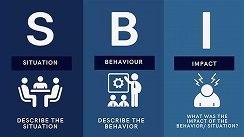
SBI (Situation–Behavior–Impact)
- When to use: Quick debriefs, micro-corrections, and praise within 72 hours.
- Steps:
- Situation Anchor time/place: “In Monday’s stand-up…”
- Behavior Observable act (no traits): “…you spoke over Maria twice…”
- Impact Concrete effect: “…which shut down her update.”
- Next step One change + date: “Next time, I’ll moderate with hand-raise; let’s assess tomorrow.”
Do/Do not: Do use recent facts; do not infer motives. Keep to one behavior.
Two examples:
- Praise: “In yesterday’s client demo (S), your concise summary (B) clarified scope (I). Please keep opening that way.”
- Improve: “In shift handover (S), you left actions ownerless (B); ops stalled (I). By 16:00 today, add owner + due date.”
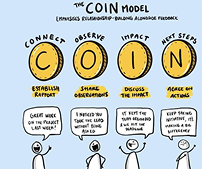
COIN: Context-Observation-Impact Next Steps
- When to use: Coaching, development, or when more explanation helps.
- Steps:
- Context Tie to goal/standard: “On the Q3 forecast call, aiming for a clear risk picture…”
- Observation Specifics: “…you used clean visuals and paused for questions…”
- Impact Outcome: “…which calmed the client and sped decisions.”
- Next step Add a concrete improvement: “Next time, include a one-slide ‘risks & mitigations’.”
- Do/Do not: Do co-create; do not overload one improvement at a time.
- Two examples:
- Praise+: “In the audit brief (C), your pre-reads (O) cut meeting time by 20% (I). Keep the pre-read; next time, add a 2-line ‘If-Then’ for night shift (N).”
- Improve: “For the outage plan (C), tasks lacked owners (O), delaying approvals (I). By Friday 12:00, assign owners and dates (N).”
Summary
- Lock a cadence: bi-weekly 1:1s, monthly retros, quarterly development conversations. (Frequent feedback links to engagement and accuracy; annual surprises hurt fairness and retention.)
- Make it safe: state fallibility, thank other when they are being honest, and respond without retaliation; practice humility and ask for upward feedback first.
- Be context-smart: match directness to risk; adapt for culture and power distance; choose the right channel and document agreements.
- Upgrade quality: keep feedback behavioural and specific; set one next step with a date; close the loop.
- Measure and learn track frequency, climate, and adoption; compare performance and retention over time to prove impact.
Call to action: Make feedback your everyday operating system quick, specific, respectful, and relentlessly improvement-focused. Lead with humility, protect psychological safety, and use clear structures to keep conversations fair and useful. The payoff is real: higher engagement, stronger performance, safer operations, and a faster learning curve for your team.
.png)
